

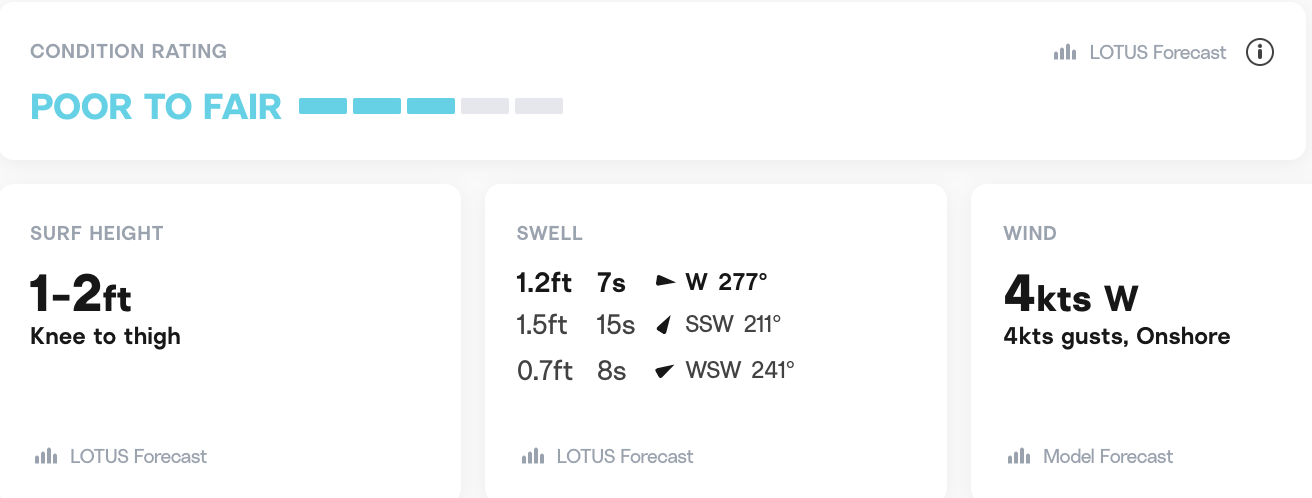
Nowadays, Surfline is the premiere surf forecasting app/service. However, Surfline has managed to put so much science into the art of surf forecasting, it’s almost too much to understand. That’s why I’m breaking down the basics of how to read Surfline for beginners and casual surfers. After all, we aren’t all pro surfers as much as we strive to be!
When you look under the hood of Surfline, there are tons of charts and metrics. Many of that them are overloaded and the metrics that matter – are difficult to understand. If you are looking to understand some of the basic surf forecast metrics beyond the ratings (Poor to Fair> Fair>Fair to Good) – I’ll try to help.
The 3 key metrics that are most important to read Surfline or any surf forecast are wave height, swell direction, and winds.
Wave Height
We’ll start with the easiest Surfline metric. Wave height when reading a surf forecast is pretty self explanatory. Wave height is measured in feet from the front of the wave unless you are in Hawaii. If you are totally new to surfing and wondering what a good/safe wave height is; you want to start in waves 1-3ft. Waves in the 3-4ft range are considered playful and great for intermediate surfers as your skills progress. When waves are 5-6ft plus, they are not only powerful but the currents can also be strong. As such, I wouldn’t recommend surfing in waves over 4ft unless you are a comfortable surfer and swimmer.

Swell Direction
Swell direction is perhaps the most important but least understood metric on Surfline. Swell direction is a useful guide to help you determine which breaks will be receiving the best swell.
For example, in San Diego S + SW swells from the South are more common during Summer. These swells originate from places in the South Pacific like Hawaii. This means that coastline facing South will be most open to receiving these waves. In San Diego, this means places like Oceanside and Trestles. North County San Diego is a Summer swell magnet.

On the flip side, North swells are most common during Winter months. These swells originate from places in the North Pacific like Alaska. This means that coastline facing North will be most open to receive these waves. In San Diego, that translates to places like Blacks beach, Sunset Cliffs and the La Jolla reefs.
So, when reading a Surfline forecast that reports a S or SW swell, you want to find a break to surf that receives this type of swell direction. Surfline generally does a good job of identifying which breaks are good for which swell directions, as I do in my surf reviews.
Winds
The final important metric to know how to read Surfline is wind. By default, Surfline reports wind as knots but you can change to miles per hour. Knots exist as they are used by sailors. You would have to multiply knots by 1.15 to get the equivalent MPH.
Generally, any wind under 5 knots is considered a light wind and good for surf conditions. When the wind is 5 knots or above, the ocean surface will become more textured. Anything above 10 knots is pretty blown out.
Finally, there are onshore, offshore, and side shore winds. Onshore winds blow from behind the wave toward shore, causing the wave to crumble over. Strong onshores are bad. Offshore winds are the most desirable type of winds for surfing. They blow out to sea from land. Offshore winds are good because they hold the face of the wave open for great shape. You can geek out on offshore winds here.

Got it? Now you are a pro and you know how to read Surfline like the best of them!
Alternatives to Surfline
Unfortunately, all the major competitors to Surfline (like Magic Seaweed), got gobbled up. There aren’t many global surf forecasting services available but local forecasting services still exist.
One of my favorites in San Diego is calling directly into the City of San Diego Lifeguard Services. They leave a daily recording every morning for beach, surf and dive conditions @ 619-221-8824.
Finally, I release my own weekly San Diego surf forecast via a newsletter. While it sources a lot of the information from Surfline, I break down the forecast in a more digestible bite for everyone to understand. I include a summary for the week along with highlights for days and specific waves to target based on the conditions. If you are struggling a bit on how to read Surfline, follow along with the Sunday Stoke for a fun, easy to read local forecast.
What did you think of my forecast breakdown?
Listen or read my interview on how to read Surfline with Zuz from the Wipeout Weekly.